

COURSE OVERVIEW
The Civic Documenter program trains community members to observe, document, and explain what happens in local public meetings. Students will learn how local government works, why open meetings matter, how to take accurate notes, and how to identify information that is newsworthy and useful to their community. By the end of the course, students will be prepared to attend public meetings as Civic Documenters and contribute clear, accurate summaries to local news outlets. No prior journalism experience is required.
CLASS FORMAT
- Five online sessions (via Zoom)
- One in-person session at a partner news outlet
- Weekly homework includes short readings, videos, and watching public meetings
LEARNING GOALS
By the end of this course, students will be able to:
- Explain why local news and public meetings matter
- Identify different types of municipal and school boards and what they do
- Understand New Hampshire’s Right-to-Know and Open Meeting laws
- Find and read meeting agendas, minutes, and packets
- Take clear, accurate notes during public meetings
- Identify what information from a meeting is newsworthy
- Use AI tools responsibly to help summarize meetings (with careful fact-checking)
- Participate as a Civic Documenter with a local news partner
INSTRUCTORS
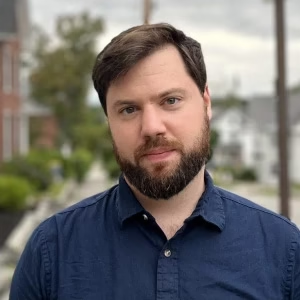 Paul Cuno-Booth most recently reported on health and equity for NHPR. His work focused on questions about who is able to access health care in New Hampshire, who is left out, and how that affects their health and well-being. He investigated the barriers that make it hard for people to get care – including financial barriers – and what people in power are or aren’t doing to make things better. Cuno-Booth also worked at The Keene Sentinel for four years as a reporter and editor, and has written for the Granite State News Collaborative, BusinessNH magazine and other outlets in New Hampshire and Vermont.
 Richard C. Gagliuso is a seasoned attorney and serves of counsel to the firm Bernstein Shur in Manchester. His practice focuses on construction law and First Amendment issues. Gagliuso has decades of experience representing contractors, media entities, and businesses in complex legal matters. His practical approach and deep understanding of his clients’ industries make him a trusted advisor in navigating legal challenges. Relative to his media law practice, Gagliuso has represented clients on matters including libel and privacy claims, access to public records and proceedings, and legal issues in newsgathering and reporting.
SCHEDULE AND ASSIGNMENTS
Week 1: The Basics
Feb. 25 | Zoom | 6 p.m. to 7:30 p.m.
- What is local news?
- Why does it matter?
- Why do we cover municipal meetings and why are they important?
- Basic vocab and concepts.
- On record/off record.
- What makes something newsworthy?
Homework:
Read
Watch
Week 2: What is a Public Meeting
March 4 | Zoom | 6 p.m. to 7:30 p.m.
- What counts as a public meeting?
- Different boards and their roles.
- Open meeting basics:
- What is public?
- What is not public?
- When can boards enter nonpublic session?
- What must be disclosed about closed sessions?
- What happens to meeting minutes?
- Parts of a meeting.
- How to find and read an agenda.
Homework:
Read
Watch
Meeting Assignment
-
- Watch a live-streamed public meeting selected by the instructor.
- Find:
- The meeting agenda.
- Minutes from the previous meeting.
- Come to class prepared with:
- Up to three items discussed that were newsworthy.
- Names of speakers.
- Any votes taken and how board members voted.
- Request the meeting packet ahead of time and review it
Week 3: Public Records
March 11 | Zoom | 6 p.m. to 7:30 p.m.
- Class Discussion: Meeting Debrief
- What is a public record?
- How to ask for public records.
- How to file a Right-to-Know request.
- What documents typically come out of meetings?
- What is public and what may be exempt?
Homework:
Public Record Assignment
-
- Identify one public record you want to obtain and write a draft Right-to-Know request to share in class.
Read
Watch
-
- The Keene State Five
- A livestream of a public meeting chosen by the instructor.
- Find the agenda for the meeting.
- Find the minutes of the previous meeting.
- Fill out the notes template and bring with you to next class for discussion.
Week 4: Taking Notes
March 18 | Zoom | 6 p.m. to 7:30 p.m.
- Class Discussion: Meeting Debrief
- How to take fast, accurate notes during meetings.
- What information must always be in your notes.
- Recording meetings for note-taking purposes.
- Taking photos in open meetings.
- Using AI tools to help turn notes into summaries or short news stories.
- Important: Why you must double-check everything — AI will make mistakes.
Homework:
Read
Watch a live-streamed public meeting selected by the instructor.
-
- Find the agenda and previous minutes.
- Complete the notes template.
- Use AI to draft a short summary or news brief.
- Carefully fact-check the draft against your notes.
Week 5: Ready, Set, Document!
March 25 | Zoom | 6 p.m. to 7:30 p.m.
- Class Discussion: Meeting Debrief.
- How Civic Documenter assignments work.
- What editors expect from documenters.
- Submitting work and getting feedback.
- How to use Google Docs and Folders.
- What happens after the class ends.
- Survey
Homework:
-
- Fill out a W9 and this CivDoc Participant agreement and send it to Melanie Plenda , executive director at Granite State News Collaborative at melanie.plenda@gmail.com.
- Sign up to cover a town or towns (no more than two for now).
- Bookmark this folder. It will have all of your after workshop materials.
- Create a folder within that folder with your town names on it. This will be your working folder. You can keep agendas, meetings, notes and work on your stories here.
- You can access all notes, handouts and videos from the workshop through this link.
- Review:
Week 6: Meeting the Newsroom
April 1 | In Person at Partner News Outlet | 6 p.m. to 7:30 p.m
- Meet editors and newsroom staff.
- Walk through the documenter workflow.
- Ask questions and get ready to take assignments.